The average business running digital signage manages 2.1 screens. That sounds like most businesses build up a small network of displays over time, until you check the median: exactly 1.
The gap matters. A handful of larger accounts, agencies managing screens across client sites, multi-location retailers, pull the average up. Most businesses never go past a single screen, and it works fine for them. You don't need to plan a rollout. One screen, run well, is the norm here.
These numbers come from Juuno's own platform: anonymized usage data across 5,000+ active businesses already running digital signage. Real screen counts, real hardware choices, real content, real schedules. This page updates as more data comes in, so treat it as a reference you can check back on.
If you want digital signage basics first, start with what digital signage actually is. Otherwise, here's what the data shows: screens per business, hardware choices, content, and scheduling patterns.
How we pulled this data
Every number on this page, unless stated otherwise, comes from anonymized aggregate usage data across Juuno's platform: 5,000+ active businesses, pulled in June 2026. Juuno can see exactly how many screens, playlists, and content types each anonymized account runs.
I've found that account-level usage data tells a more accurate story than a survey ever does. Self-reported answers tend to skew toward what sounds impressive. Platform data just shows what people actually do.
This page gets updated as more proprietary data becomes available. That's why it lives on its own instead of being folded into another article.
The digital signage market small businesses are stepping into
Before getting into what small businesses actually do with their screens, it helps to know this isn't a fringe purchase. The global digital signage market was valued at $31.09 billion in 2025 and is projected to reach $33.56 billion in 2026 (Grand View Research, 2026). From there, it's projected to climb at a compound annual growth rate of 8.2% through 2033, reaching $58.42 billion.
That number comes with a catch worth naming directly. Most market sizing reports like this one are built around enterprise hardware and large retail deployments. Hardware alone holds the largest share of that revenue, and video walls get counted right alongside a $99 stick plugged into a café TV. The market-level figure proves digital signage is a real, growing category. It doesn't describe what a business running one or two screens actually experiences day to day.
That gap is exactly what the rest of this page fills. The platform data below isn't scaled down from an enterprise average. It's pulled directly from the accounts small businesses are running right now, at the scale most of them actually operate.
How many screens the average small business actually runs
Across the 5,000+ businesses on Juuno's platform, 19,539 active screens are being managed right now, which works out to 2.1 screens per business on average.
The accounts pulling that average up are usually white label resellers running screens across many client locations, or multi-location retailers managing several storefronts at once.
Screens per business, broken down
The full breakdown makes the pattern even clearer. 77% of businesses run exactly one screen, 18% run between two and five, 5% run six to twenty, and under 1% run more than twenty.
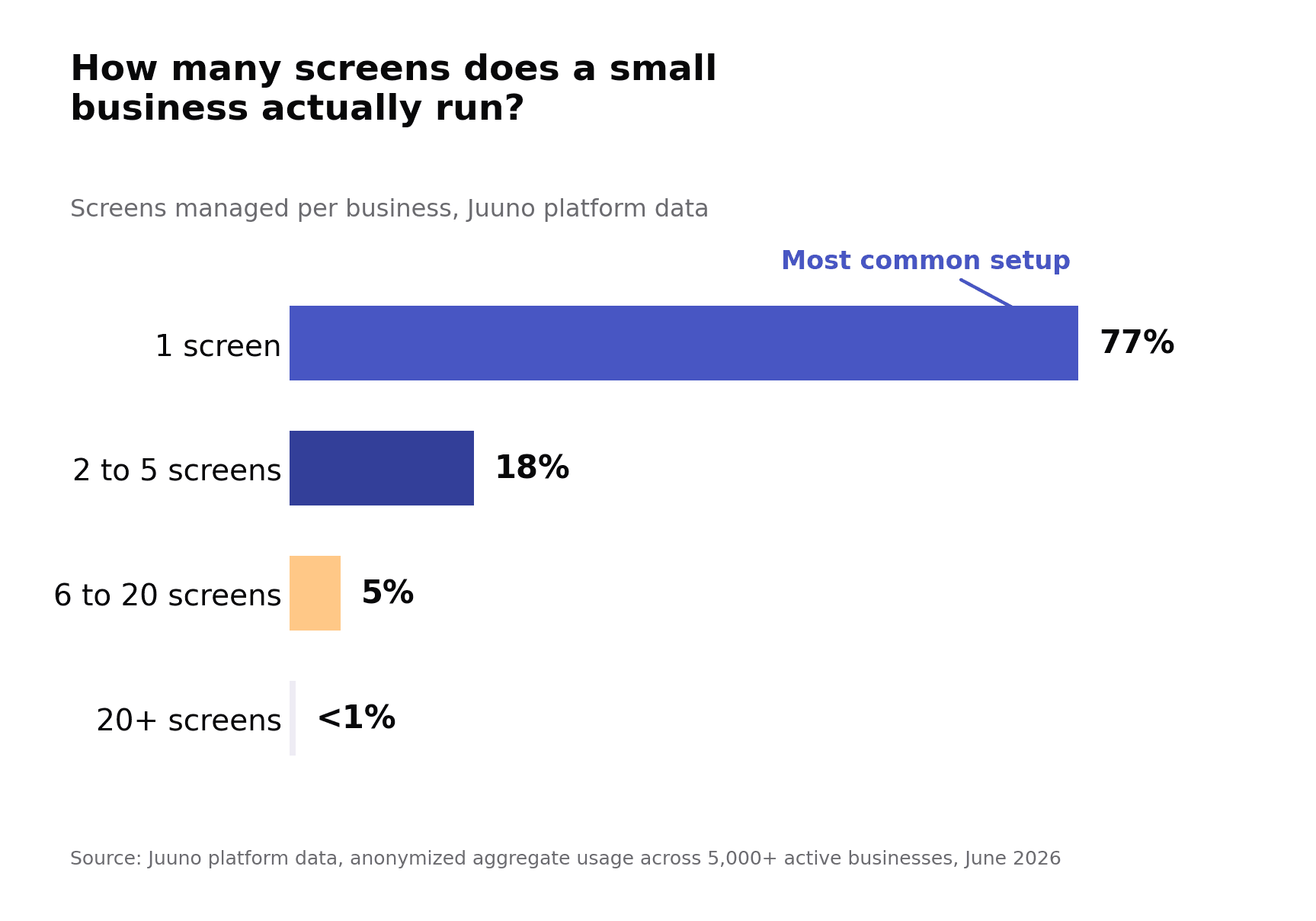
Scaling up later is normal, not something to plan for on day one. Start with the screen you need right now. One screen, run well, is the norm here, not a compromise version of a bigger setup you'll eventually need. Compare prices for the top platforms here.
Landscape or portrait: how businesses actually orient their screens
Landscape dominates. 92% of screens on Juuno's platform run landscape, with just 8% set up in portrait.
A gym lobby, a waiting room, a retail counter: these all favor a wide format because that's how the eye naturally scans a wall-mounted screen. Landscape is the safer default unless you have a reason to go portrait, like a narrow hallway or a tall menu list. Portrait still has its place: a narrow entryway, a single-column menu board, a vertical kiosk near a checkout line. It's just not where most businesses land.
What's actually running the screens: browsers, players, and everything in between
I've talked to enough facilities and ops managers to know that "we'll get to updating the screens" usually means never. The businesses that stick with digital signage long term are almost always the ones who picked hardware that matched how hands-on they wanted to be. They didn't just pick whatever looked most impressive in a sales demo.
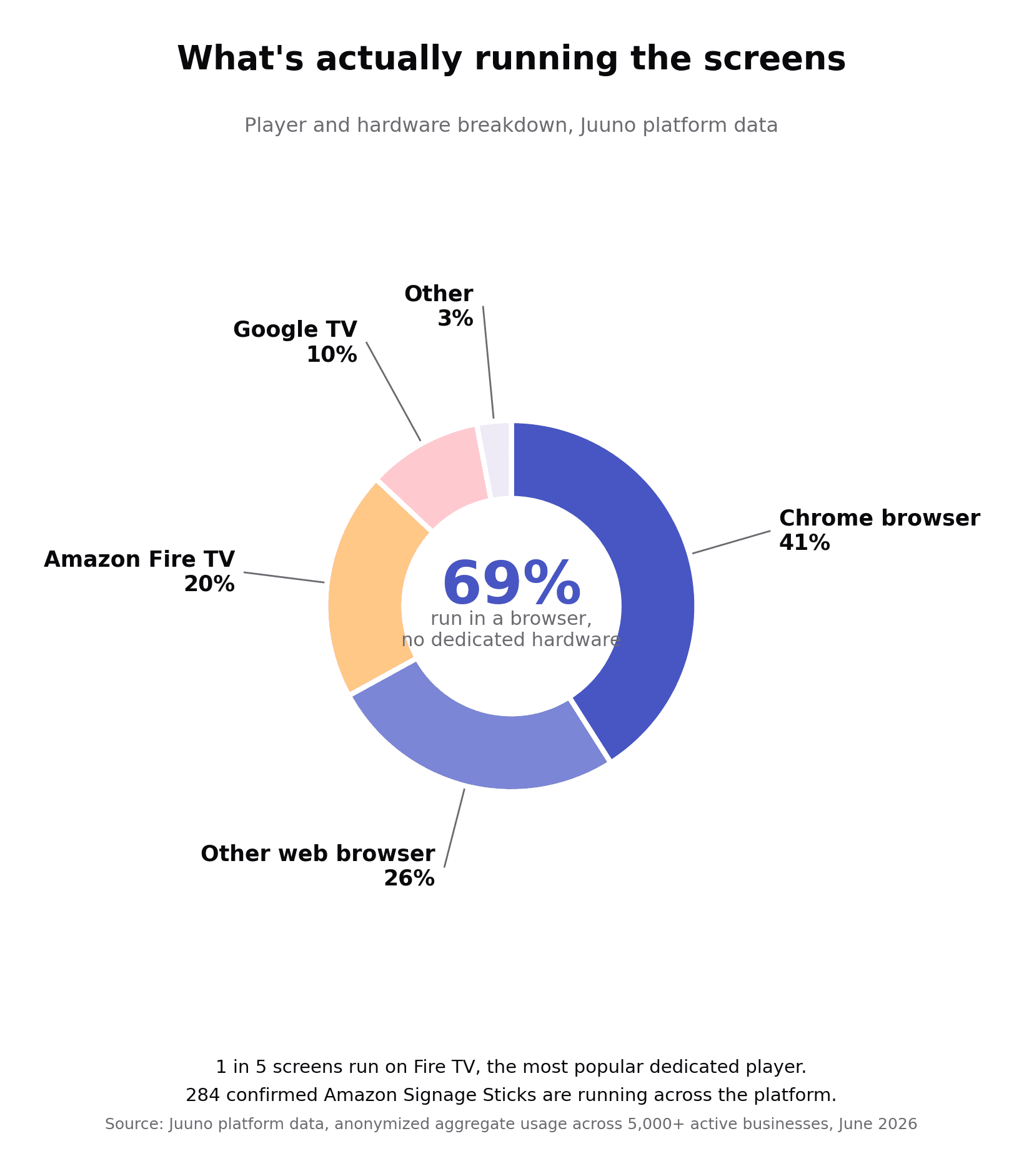
Here's what's actually plugged in across Juuno's platform: 41% of screens run through a Chrome browser, another 26% run through some other web browser. Amazon Fire TV powers 20%, Google TV powers 10%, and the remaining 3% run on other setups.
Add the two browser categories together and 69% of screens need no dedicated hardware at all. Roughly 1 in 5 screens run on Fire TV, the most popular dedicated player on the platform. 284 confirmed Amazon Signage Sticks are running across accounts right now.
None of this means browser-based signage is the only right answer. It's the lowest-friction way to get a screen live today, and a large share of businesses never feel the need to change. Dedicated players like Fire TV and the Signage Stick earn their place when a screen needs to stay up around the clock. If you want a full breakdown of both approaches, our guide to choosing digital signage software covers the tradeoffs in more depth.
"What surprises people most when they see the hardware data is how many businesses start on a browser and never feel the need to change. It only becomes a problem if the screen matters enough that a random reboot or update actually costs you something." — Matt Stone, Co-founder, Engineering, Juuno
What businesses actually put on their screens
Images still dominate. 94% of businesses on Juuno's platform display images, well ahead of 44% for video, 26% for social media, and 26% for announcements. Canva designs come in at 15%, YouTube at 7%, and weather at 6.5%.
If you've held off on digital signage because you assumed you needed a video production budget, the data says otherwise. A static image, updated on a schedule, is still what most screens are actually showing.
Social content breaks down further: Instagram shows up on 23% of businesses' screens, YouTube on 7%, X on 2.6%, and Facebook on 2.4%. Roughly 1 in 4 businesses pull in social content at all, and when they do, Instagram is the clear default.
Upload formats round out the picture: PNG makes up 43% of what's uploaded, JPEG 36%, MP4 video 14%, and PDF just 2%.
If you're planning your first playlist, a handful of well-designed images and a Canva template will get you further than a complicated content calendar. See our guide to digital signage content managers if you're ready to organize all of it in one place. If food and drink pricing is what's going on your screen, our menu display software guide and digital menu boards page cover that setup specifically.
How businesses schedule and manage their signage
A retail business I looked at while researching this piece ran the exact same slideshow on loop, all day, every day, for months. Then they switched to a simple weekday-versus-weekend schedule that matched their actual foot traffic. They stopped promoting weekend-only offers to an empty store on a Tuesday morning.
The average Juuno account runs 3.4 playlists and 5.5 slides per playlist, with 35 media files uploaded per account. Only 8% of businesses use time-based scheduling at all.
That last number is the opportunity hiding in this data. Most businesses set up a playlist once and let it run. A small amount of dayparting effort puts you ahead of 92% of the businesses on this platform.
Timing follows a clear rhythm too. 8am is the single most common schedule start time, with 9am close behind, and activity dropping steadily through the afternoon and evening. A midnight spike shows up as well, reflecting all-day schedules that simply start at 12:00am.
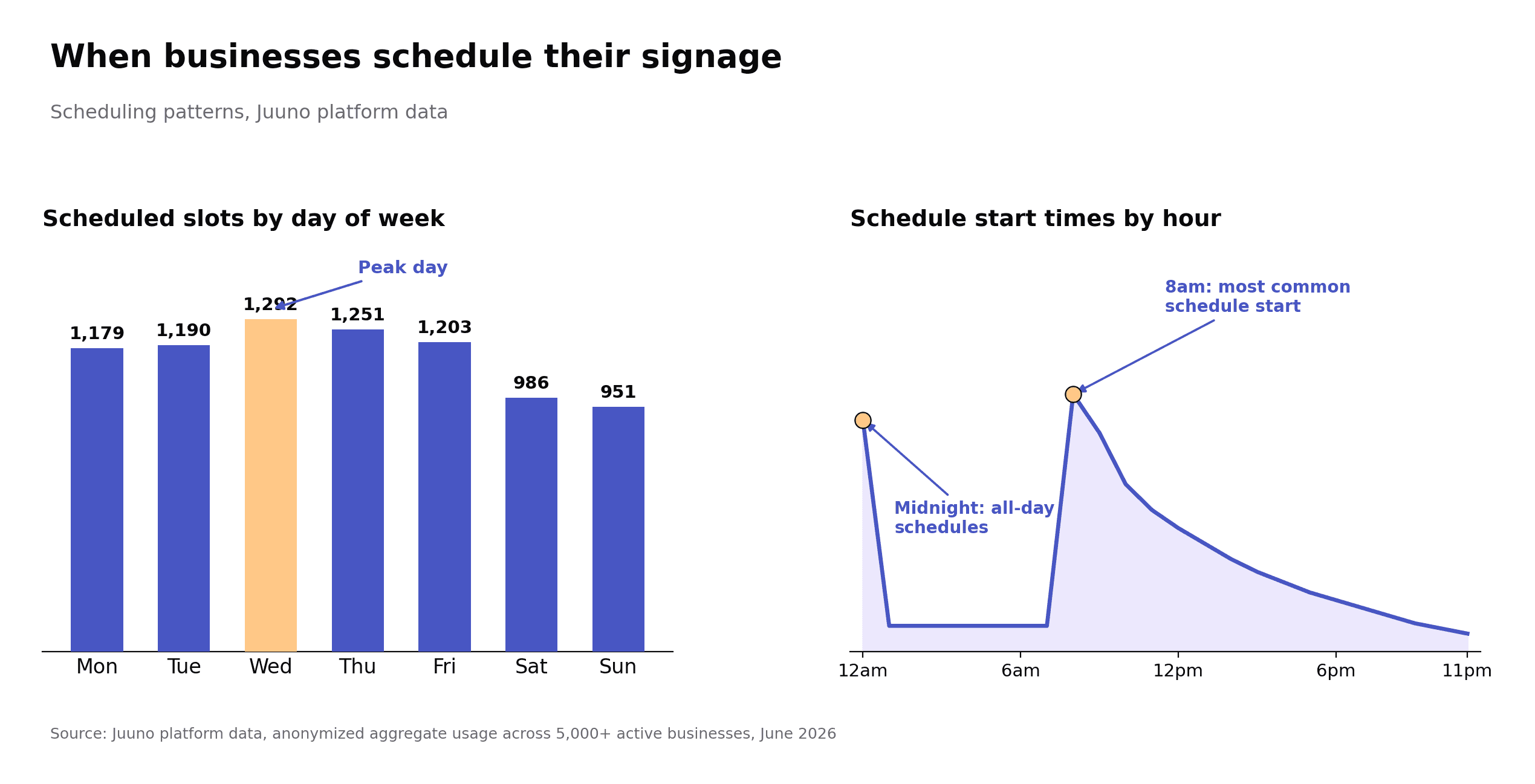
Wednesday sees the most scheduled activity of any day, with 1,292 scheduled slots, followed by Thursday, Friday, Tuesday, and Monday. Saturday and Sunday both fall well behind. Weekday scheduling runs about 25% more often than weekend scheduling overall.
"The businesses getting the most out of their screens actually look at when their customers show up and schedule around that instead of just hitting publish once and walking away." — Thomas Garrood, Co-founder, Engineering, Juuno
Digital signage statistics FAQs
How many screens does the average small business run?
Across Juuno's platform, the average business runs 2.1 screens, but the median is exactly 1. Most businesses start with a single screen and stay there. Multi-screen accounts tend to be agencies managing several client locations or retailers with more than one storefront, not the typical single-location small business.
Do I need special hardware for digital signage, or can I just use a smart TV browser?
You can start with just a browser. 69% of screens on Juuno's platform run through a Chrome or other web browser with no dedicated hardware. Dedicated players like Amazon Fire TV or the Amazon Signage Stick become worth the switch once a screen needs to run unattended, around the clock.
What kind of content should I put on my digital signage screens?
Start simple. Images make up 94% of what businesses display, far more than video, social feeds, or announcements. A handful of well-designed static images, built in a tool like Canva, gets a new screen live faster than a video schedule. If you're outfitting a sales floor, see our retail digital signage guide for content ideas specific to that setting.
Is the digital signage market actually growing?
Yes. The global digital signage market was valued at $31.09 billion in 2025 (Grand View Research, 2026). It's projected to grow at an 8.2% compound annual rate through 2033, reaching $58.42 billion. That figure leans heavily on enterprise deployments, so treat it as proof the category is real, not a benchmark for your own screen count.
How often should I update my digital signage schedule or playlist?
Only 8% of businesses on Juuno's platform use time-based scheduling, which means most are leaving an easy win on the table. Even a basic weekday-versus-weekend split, or a morning-versus-evening swap, puts your screen ahead of most setups still running the same static loop all day.
This page will keep growing as Juuno pulls more proprietary data, so the numbers above are a starting point, not a final word. One screen, a browser, a handful of images, updated more often than not. If that's your plan, you're already thinking about digital signage the way small businesses actually use it.
Juuno starts at $5 per screen per month, runs in a TV's own browser, and comes with a 7-day free trial, making it the best digital signage platform for small businesses.
See our full guide to digital signage software if you want to compare options before you start.
If you run an agency, learn more about our white label signage program.


Dayana Mayfield is a SaaS content strategist and copywriter with 11 years of experience and 196 clients served across the software industry. She's been featured in Forbes, Business Insider, and Entrepreneur, and specializes in turning brand authority into B2B content through real expert interviews and proprietary research. She covers digital signage software and digital menu boards for Juuno. When not writing marketing content, Dayana can be found plotting a SciFi novel or chauffeuring her theater kids to rehearsals.
