Digital signage (also known as electronic signage) refers to using electronic display screens to showcase information, advertisements, and other multimedia content to the public.
It is visible everywhere, quickly replacing traditional advertising methods (such as print media), and has proven to be an effective way to capture the attention of your intended audience.
Digital signage tools include billboards and screens. These displays are designed to catch their audience's attention using high-definition, vivid, and bold colors.
The digital signage market has grown over the years due to the constant demand for innovation and the need to interact with others. With the introduction of technologies such as Artificial Intelligence, Mobile Integration, and the Internet of Things (IoT), the future of digital signage looks promising.
There are numerous advantages of digital signage over the traditional (print) method. Some of them include:
Real-time updating of content displayed
More cost-effective in the long run
Their interactive feature improves customer engagement
Ability to perform customer analysis and track performance.
Content can be directed to a specific audience, enhancing its effectiveness.
Some examples of digital signage in businesses
There are several examples of outstanding digital signage businesses, which could provide ideas on how to go about setting one up. Some of these include:
1. McDonalds: Digital signage at the point of sale
By using digital signage, McDonald's improved order accuracy and customer delight. As part of their “Experience of the Future” initiative, they introduced digital signage touchscreen kiosks in their restaurants. The kiosks allowed customers to place their orders digitally, customize their meals, and make payments, all without the assistance of a cashier. This resulted in overall order accuracy, faster service, upselling opportunities, and enhanced customer experience.
2. Tesla: Digital signage and the retail showroom
Tesla both educated and engaged customers in their showrooms with interactive digital displays.
To educate their clients about their electric vehicles and other innovative solutions, Tesla provided touch screens that enabled customers to explore the different models and provide them with a virtual experience of their future purchases. They also included virtual test drives and real-time displays of Tesla’s products.
This resulted in increased sales, brand recognition, and data collection, to boost future marketing strategies.
3. Adidas: Digital signage at pop-up stores
Through digital signage displays, Adidas enhanced customer engagement and excitement in their pop-up stores. During the holiday season, Adidas opened up a pop-up store in a high-traffic location to create a memorable shopping experience for its customers.
They used high-definition screens to display their products, interactive digital mirrors for fitting purposes, and display screens to showcase flash sales and executive offers. They equally integrated the digital screens with their social media platforms, to display customer reviews.
The above strategies increased foot traffic to their stores, increasing sales, customer excitement, visibility, and real-time marketing.
4. Sweet Delights: Digital signage at a bakery
Sweet Delights Bakery is a small family-owned bakery that used digital signage to transform its business, leading to business growth and customer engagement.
They positioned their digital signage in strategic locations that attracted massive foot traffic and enhanced the customers' in-store experience at the bakery.
The result was increased sales, customer satisfaction, and efficient marketing strategy.
5. Levi's Stadium: Digital signage at the Superbowl
Legends partnered with Meridian to install an interactive kiosk at Levi’s Stadium. The digital kiosk's interactive function allowed Superbowl attendees to browse exclusive merchandise and purchase it later.
This resulted in customer attraction and engagement, and increased sales, especially during the event.
How to create effective digital signage
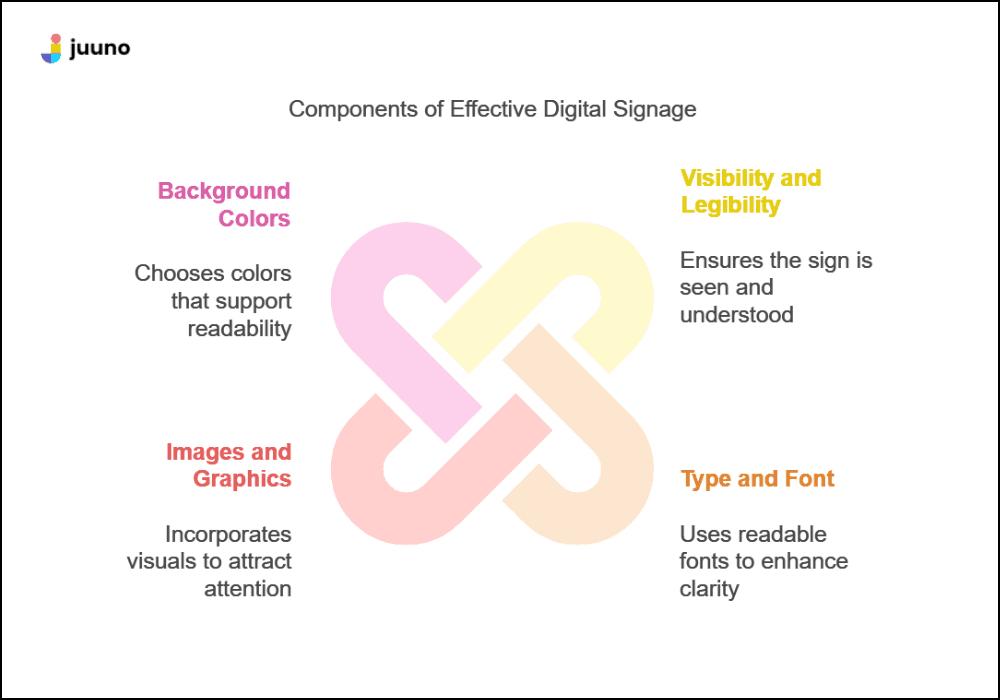
There are design principles used to create effective and high-impact signage that appeals to the target audience. They include:
Keep it visible and legible: Visibility is the most important part of digital signage. The digital signage’s location is important because it ensures it is seen by your target audience. Other important things to consider include the shape and size of the digital sign, especially concerning distance from people’s view. Finally, the message displayed should be clear and straight to the point.
Type and Font: Words displayed should be easy to read, especially from a distance. As a general rule, one should not use more than two different fonts in a single design. Complementing fonts can make your message stand out and legible.
Images and Graphics: Full-color graphics such as logos, graphics, artworks, etc. create a visually appealing effect and enhance the design and layout of the digital signage.
Background Colors: It is important to use background colors that do not distract from the main message being displayed. Black contrasts with white colors and enhances legibility, especially from a distance.
Advantages of using digital signage in your business
The benefits of using Digital Signage are numerous, and include the following:
Increased Brand Awareness: Digital Signage drives traffic and boosts brand awareness. Displaying brand messages, vision, mission, goals, etc., increases knowledge of the brand and what it stands for.
Increased Sales: Increased brand awareness usually translates to increased sales. Digital displays such as point-of-sale displays promote best-selling products and seasonal products and provide opportunities for upselling and cross-selling their products.
It combines the physical and online store experience: Customers have the opportunity to view a company’s products and shop online, without the hassles of waiting in queues to be attended to.
Customer Information and Education: Digital signage is used to provide relevant information to a target audience. It also includes displaying announcements or information on Television. Information about promotions, discounts, etc is easily communicated to customers. Information about how to use products to get the best results can also be communicated via Digital signage.
Efficient and Effective Communication: This is especially relevant in an office environment, where it is important to keep employees informed about important company decisions. Clear and transparent communication increases employee engagement and satisfaction in the company.
Extra Income: Companies can generate extra income from leasing a part of their digital signage space where it exists. Complementary products can be displayed alongside the company’s products to increase exposure and sales.
Wayfinding and Directions: Digital Signage can help customers navigate complex places. It also highlights important places of interest such as malls, restrooms, etc., thereby reducing confusion and creating a positive customer experience.
Social Media Integration: Integrating Social media with Digital signage increases online following. When customer feedback and reviews are displayed, it encourages customer advocacy and improves overall customer experience.
How to measure the ROI of digital signage
Investing in digital signage is one thing—proving that it delivers real business value is another. While the impact can sometimes feel intangible, there are clear ways to measure return on investment (ROI) and understand how your screens are contributing to growth.
The key is to look at both hard metrics (like sales and conversions) and soft metrics (like customer experience and brand perception). Together, these give you a complete picture of performance.
Track sales and revenue impact
One of the most direct ways to measure ROI is by analyzing how digital signage affects your sales.
Start by identifying specific products or promotions featured on your screens. Then, compare performance before and after those campaigns go live. For example, if a menu item or product bundle is highlighted on your display, you can track whether sales increase during that period.
This works especially well for:
Upsells and add-ons at the point of sale
Limited-time promotions or seasonal offers
New product launches
Over time, these small gains can compound into a significant revenue boost—especially since digital signage makes it easy to update and test different messages in real time .
Measure customer engagement
Digital signage is designed to capture attention, so engagement is another important indicator of success.
While not every business has advanced analytics tools, there are still simple ways to gauge engagement:
Observe how long customers look at screens
Monitor interaction rates with touchscreens or kiosks
Track participation in promoted content (e.g. QR codes, social media posts)
If your signage includes dynamic or interactive elements, you can also measure engagement through clicks, taps, or content views. Higher engagement often leads to better brand recall and increased likelihood of purchase.
Analyze foot traffic and in-store behavior
Digital signage can influence how customers move through your space—and what they notice along the way.
For physical locations, consider tracking:
Changes in foot traffic near displays
Time spent in certain areas of your store
Traffic to promoted sections or products
For example, placing a screen near your entrance with featured promotions can guide customers deeper into your store. Similarly, digital menus and displays can reduce perceived wait times and keep customers engaged while they queue .
Calculate cost savings over time
ROI isn’t just about increasing revenue—it’s also about reducing costs.
Traditional signage requires ongoing printing, shipping, and installation. Digital signage eliminates most of these expenses by allowing you to update content instantly from a central platform.
Over time, this leads to savings such as:
No reprinting costs for updated menus or promotions
Reduced labor for installing and replacing physical signs
Lower long-term marketing expenses
For many businesses, these savings alone can justify the switch to digital signage.
Consider the “soft” ROI
Not all benefits can be measured in dollars—but they still matter.
Digital signage improves how your business communicates and connects with people. These softer outcomes often translate into long-term gains:
Better customer experience through clear, engaging information
Stronger brand awareness with consistent visual messaging
Improved internal communication for teams and employees
Increased perception of professionalism and modernity
Even if these results are harder to quantify, they contribute to customer loyalty and overall business growth.
Use testing and iteration to improve results
One of the biggest advantages of digital signage is flexibility. Unlike static signs, you can experiment with different content and quickly adjust based on performance.
Try testing:
Different headlines or messaging styles
Visual formats (images vs. video)
Content schedules (time of day, day of week)
Then, compare results and refine your approach. Over time, this continuous improvement helps you maximize ROI and get the most value from every screen.
Common digital signage mistakes (and how to avoid them)
Even though digital signage is powerful, many businesses fail to see results because of a few common mistakes. The good news is that these are easy to fix once you know what to look for.
Overloading screens with too much text. Trying to say everything at once makes your message harder to understand. Keep content short, clear, and focused so viewers can grasp it in just a few seconds.
Poor screen placement. If your display isn’t easily visible, it won’t be effective. Place screens in high-traffic areas and ensure they’re positioned at the right height and angle for easy viewing.
Using hard-to-read fonts or colors. Fancy fonts and low-contrast color combinations might look good up close but fail from a distance. Stick to simple fonts and strong contrast to maintain readability.
Outdated or stale content. Content that never changes quickly gets ignored. Regular updates keep your signage fresh, relevant, and engaging for repeat visitors.
Lack of a clear content strategy. Random content leads to inconsistent messaging and missed opportunities. Plan your content around specific goals like promotions, announcements, or brand awareness.
Avoiding these mistakes ensures your digital signage stays effective, engaging, and aligned with your business goals.
Frequently asked questions
What is digital signage used for?
Digital signage is used to display dynamic content like menus, promotions, announcements, and social media feeds on screens. Businesses use it to inform, engage, and influence customers or employees. It’s widely used in retail, restaurants, offices, and public spaces to improve communication and visibility.
Is digital signage expensive to set up?
Digital signage is more affordable than many expect. Most software costs around $20–$25 per screen per month, and many solutions work with existing smart TVs. Juuno's lowest-tier plan is just $5 per screen per month. While there may be upfront costs for screens, businesses often save money long-term by eliminating printing and installation expenses. You can compare the pricing of the top platforms here.
Do I need special hardware for digital signage?
In many cases, you don’t need special hardware. Most modern digital signage platforms run directly on smart TVs using a web browser. Some advanced setups may require media players, but small and medium-sized businesses can usually get started with just software and existing screens.
What kind of content works best on digital signage?
The most effective content is clear, visual, and easy to understand at a glance. This includes promotions, menus, announcements, videos, and social media feeds. Content should be regularly updated and tailored to your audience to keep it engaging and relevant over time.
How often should I update my digital signage content?
Content should be updated regularly to keep it fresh and effective. Some businesses update daily (like menus), while others update weekly or monthly. Using scheduling tools and playlists makes it easy to automate updates and ensure the right content appears at the right time.
Can digital signage really increase sales?
Yes, digital signage can significantly boost sales when used strategically. Highlighting promotions, best-selling items, or limited-time offers can influence purchasing decisions. It also improves customer experience and engagement, which can lead to higher conversions and increased overall revenue over time.
Digital signage is an excellent way of getting all-year growth for your business. It can enable you to engage with your customers better and improve sales. It will also help you unlock your retail shop potential and achieve great heights.
Ready to create better business results with digital signage. Get started with Juuno, a reliable and affordable solution for digital signage content management, scheduling, and more.


Thomas leads Juuno's backend — the unglamorous engineering that keeps 10K+ screens running across 128 countries without phoning home at 3am. A full-stack developer who's spent his career in the trenches at startups, advertising agencies, and creative boutiques — quietly fluent in whatever stack the moment requires. Based in Laguna Beach.
