If you landed here, you're probably already running ScreenCloud, and the numbers aren't sitting right.
According to our data, the average account on our platform manages 2.1 screens. That's the exact size of business ScreenCloud's per-screen pricing hits hardest, since there's no volume discount to soften it.
Keep reading to go deeper into our ScreenCloud alternative recommendations, or you can take a look at how ScreenCloud compares to other vendors such as Juuno here.
ScreenCloud's published pricing in 2026 is $20 per screen per month on the Core plan and $30 on Pro, billed annually. The Enterprise plan starts at a 25-screen minimum and is quote-only. For five screens, that's between $1,200 and $1,800 a year. For twenty, it's $4,800 to $7,200. Before VAT.
Most people researching alternatives are running into one of three things:
The bill keeps growing. Pricing is per screen per month, so every new screen is another line on the invoice — there's no "buy it once" or lifetime option.
It's heavier than most teams need. ScreenCloud loads up on approval workflows, multi-tenant accounts, and governance plumbing. Useful at the very top of the market, but most buyers — from independent cafés through to multi-location enterprises — don't use those features and still get billed for them.
The stack is fussy. Several reviewers in 2025–2026 flag connectivity issues with FireTV players, content sync delays, and a Canva integration that "feels clunky" compared to dedicated tools.
The good news: every problem above has a cheaper, simpler answer. On our own platform, the average business runs just 2.1 screens. Most people reading this page aren't managing the enterprise-scale rollout ScreenCloud is priced for.
Below are 13 ScreenCloud alternatives that hold up in 2026, sorted by who they're actually for, with current pricing and a clear take on where each one earns its keep.
The shortest answer for most readers: if you want the closest thing to ScreenCloud at roughly a quarter of the price, look at Juuno. It's $5 per screen per month, runs in the smart-TV browser, includes Canva integration as a first-class workflow, and scales from a single screen to multi-thousand-screen rollouts via the Growth and White Label plans. Try it free for 7 days — no credit card.
What ScreenCloud costs in 2026
Before comparing alternatives, get the math honest. Here's what ScreenCloud charges right now:
Plan | Per screen / month | Min. commitment | Notable inclusions |
|---|---|---|---|
Core | $20 | Annual | 100+ apps, file storage, Quick Post |
Pro | $30 | Annual | Premium apps, dashboards, QR analytics |
Enterprise | Custom | 25-screen minimum | SSO, design support, free device on annual |
Ten screens on Pro = $3,600/year before tax. Twenty screens on Enterprise (custom-quoted, but Pro pricing as a floor) = $7,200+/year. Compare that against the alternatives below.
Heads up on hardware. ScreenCloud sells dedicated media players ($299–$549). From our data, 69% of screens on Juuno run with no dedicated hardware at all. Most ScreenCloud switchers don't replace that hardware bill, they just stop paying it. Most of the alternatives in this guide skip media players entirely — the smart TV's own browser, or a $99 Amazon Signage Stick, is enough. Browser-based platforms remove a recurring hardware cost most people don't realise they're paying.
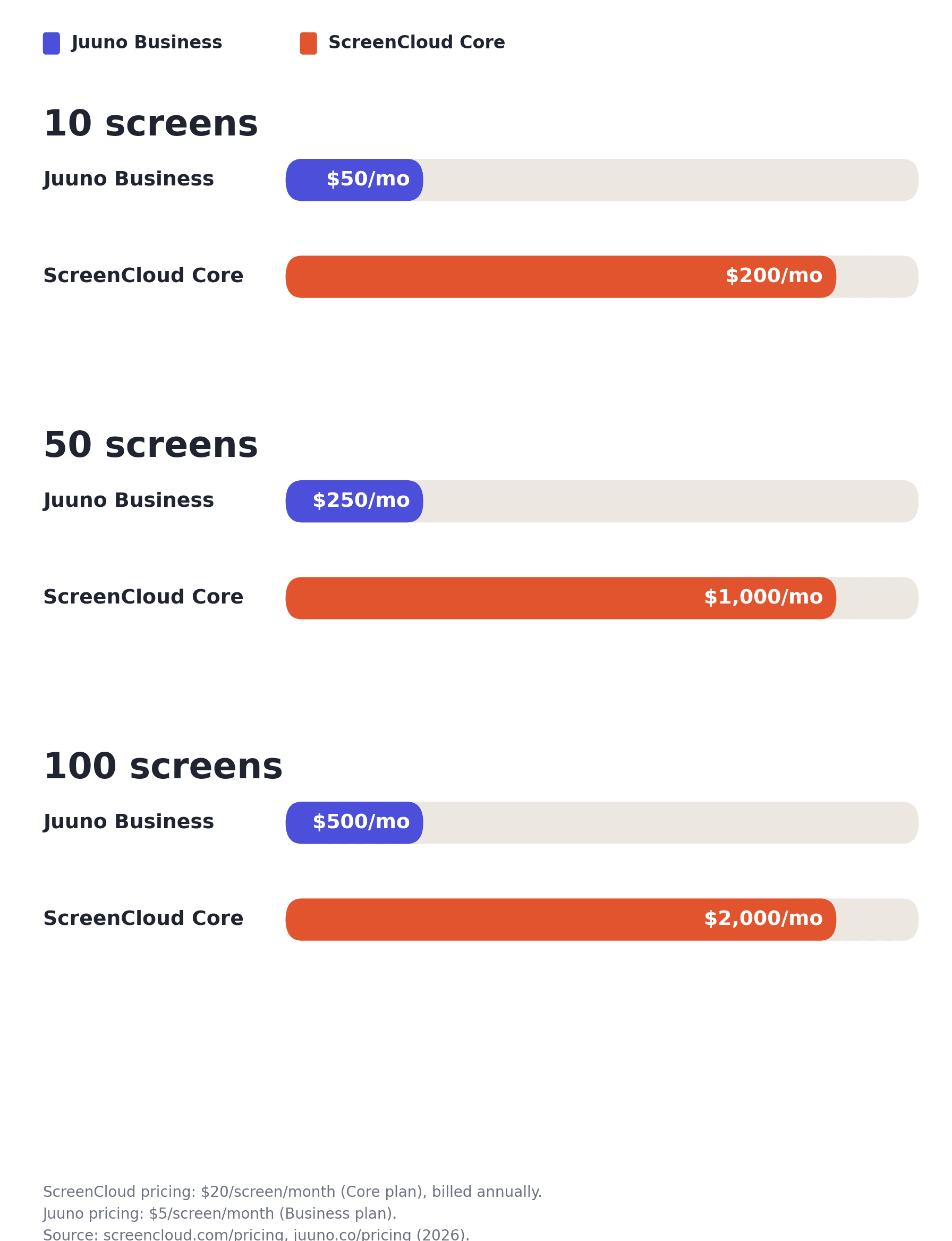
Juuno vs. ScreenCloud: the real cost at 10, 50, and 100 screens
You don't need to take a vendor's headline rate on faith. Here's what both platforms actually cost once you multiply by your screen count and by 12 months.
Screens | ScreenCloud (Core, $20/screen/month, annual) | Juuno (Business, $5/screen/month, annual) | Annual savings |
|---|---|---|---|
10 | $2,400 | $600 | $1,800 (75% less) |
50 | $12,000 | $3,000 | $9,000 (75% less) |
100 | $36,000 | $6,000 | $30,000 (83% less) |
ScreenCloud's Core plan runs $20 per screen per month and its Pro plan runs $30, both billed annually, with the Enterprise tier starting at a 25-screen minimum and priced by quote.
Juuno's Business plan runs $5 per screen per month, Growth runs $9, and White Label starts at $100 per month flat for the first 20 screens, then $5 per additional screen.
Neither number above includes tax. ScreenCloud's published rate excludes VAT, which adds another 20 percent or more in the UK and other VAT regions. Juuno's pricing is flat regardless of region. Both figures are software cost only, too. ScreenCloud sells dedicated media players starting at $299, while Juuno runs on a $99 Amazon Signage Stick or your smart TV's own browser, so the real-world gap runs wider than the subscription line alone shows.
At 100 screens, ScreenCloud's own published pricing doesn't apply cleanly. That screen count sits well past the 25-screen Enterprise minimum, and Enterprise is quote-only. The $36,000 figure above uses Pro pricing as a conservative floor. Your actual Enterprise quote could run higher.
If you specifically need proof-of-play reporting or API access, the fairer comparison is ScreenCloud Pro against Juuno Growth, not Business. Even there, Juuno's $9 per screen sits at less than a third of ScreenCloud's $30, so the gap holds at every tier, not just the entry-level plan.
The gap doesn't close as you add screens, and that's the part most comparison pages skip. Juuno's White Label base fee tracks the same $5-per-screen rate the Business plan uses, so growing from 20 screens to 200 doesn't push you into a steeper curve the way ScreenCloud's tiers do.
I've pulled this math for enough SaaS clients switching platforms to know the pattern: buyers fixate on the sticker price and skip the screen-count math entirely. At 10 screens that gap is real money. At 100, it's the difference between a signage line item and a signage budget line.
"Juuno was the easiest to use and weirdly the cheapest! You don't make it harder than it needs to be. Digital signage should just be drag and drop." — Vanessa Lopez, Fi
See the full cost of digital signage breakdown if you're modeling a budget beyond these three screen counts.
What I'd check before you sign a ScreenCloud contract
Four questions cut through the noise:
Does it run in the smart TV's browser?
If yes, you don't need to buy media players. Your TVs are the players. This is the single biggest cost difference between platforms.What does the all-in cost look like for your number of screens?
Multiply per-screen-per-month by 12 by your screen count. Add hardware. Add any minimum-screen tier. ScreenCloud's $20 turns into $200–$280 per screen per year. Juuno's $5 turns into $60.How is content actually created?
If you already use Canva, pick a tool that integrates Canva natively. If you don't, look for a built-in template library. Avoid platforms where "design" means uploading a PDF you made somewhere else.Will the support team answer when something breaks at 4pm on a Friday?
Read recent reviews on G2 and Capterra. Look at response time, not just rating. Small SaaS often beats enterprise support here because there's no first-line filter.
ScreenCloud vs top alternatives: quick comparison
| ScreenCloud | Juuno | OptiSigns | Yodeck |
|---|---|---|---|---|
Starting price | $20/screen/mo | $5/screen/mo | $10/screen/mo | Free (1 screen) / $8/screen/mo |
Media player required | Yes ($299–$549) | No — runs in smart TV browser or $99 Signage Stick | No | Raspberry Pi (provided free on annual plans) |
Canva integration | Yes | Yes (native) | Yes | No |
Free trial | No | 7 days, no card | 7 days | 1 screen free forever |
Best for | Enterprises needing approval workflows | Most businesses — cafes through to 1,000+ screen rollouts | Retail and interactive kiosks | Tech-comfortable teams happy with Raspberry Pi |
The 13 ScreenCloud alternatives I'd actually consider
These are the best platforms to consider.
1. Juuno - best all rounder
Pricing: $5/screen/month (Business), $9/screen/month (Growth, with proof-of-play and API), White Label from $100/month (20 screens included). 7-day free trial, no credit card.
Why it replaces ScreenCloud for most readers:
Juuno is the closest like-for-like swap for ScreenCloud's core use case — putting content on a TV — without the price tag. It runs in any modern smart TV browser, on a $99 Amazon Signage Stick, Chromecast, or an Android tablet. There are no media players to buy, no Raspberry Pis to image.
What you get on the $5 plan that's $20+ on ScreenCloud: unlimited playlists, scheduling, screen zones, social-media widgets, RSS, weather, portrait/landscape support, and Canva integration. From our platform research, the average account already runs 3.4 playlists and 5.5 slides each, so 'unlimited' isn't a hypothetical, it's what accounts actually use.
Scales with you. The Business plan ($5/screen) handles single-location and small multi-site setups. The Growth plan ($9/screen) adds API access and proof-of-play reporting for teams that need audit trails. White Label ($100/month base, 20 screens included) is built for agencies, resellers, and large enterprise rollouts running screens for their own clients or business units. Whether you're one café or a multinational running 1,000+ screens across regions, the platform scales without forcing you onto an enterprise-only contract.
Cossin Media in Worcester, Massachusetts runs five white-label signage brands on Juuno's reseller tier, a model built specifically for agencies switching clients off higher-priced platforms like ScreenCloud. Founder Theo Cossin reports margins of 67 to 80 percent per screen after making the switch, a structure ScreenCloud's per-screen enterprise pricing doesn't offer resellers at any tier.
"Juuno is a game-changer for our seven stores across Canada. With three screens in each location, Juuno has significantly simplified our promotional campaigns." — Sam, Vanilla Vape
Multi-location buyers comparing ScreenCloud's per-screen Enterprise pricing against Juuno's flat-rate White Label tier consistently land on the same conclusion: the feature gap narrows a lot faster than the price gap does. Read the full breakdown of white label digital signage if you're evaluating the reseller angle specifically.
Trustpilot: 4.6/5.
2. OptiSigns — best for retail and interactive kiosks
Pricing: $10–$45/screen/month.
OptiSigns is a strong middle-ground choice. It's about half ScreenCloud's price, has a built-in design editor, and supports interactive kiosks on the higher tiers. Proof of play and uptime monitoring are included on Pro. The trade-off is a more crowded UI than Juuno or ScreenCloud, and the kiosk features push you up the pricing tiers.
3. NoviSign — best for schools and small enterprise
Pricing: $18–$44/screen/month. 30-day free trial.
NoviSign sits at roughly the same price point as ScreenCloud Core but adds touchscreen kiosk support, 500+ templates, and POS integrations (Toast, Zapier, Power BI) on the higher plans. 4.9/5 G2 average. The Premium plan requires a 20-screen minimum.
4. Yodeck — best for tinkerers comfortable with Raspberry Pi
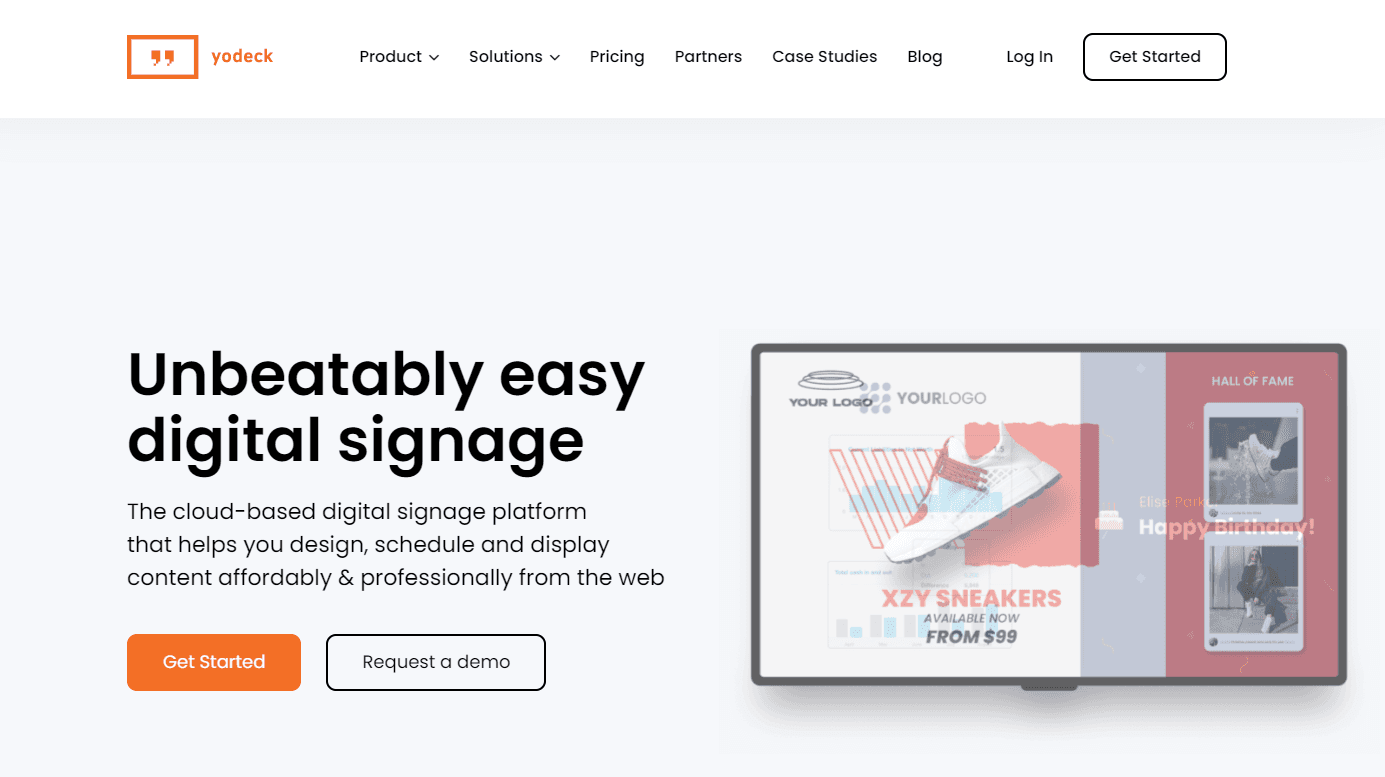
Pricing: Free for 1 screen; $8–$15/screen/month after that.
Yodeck has the strongest free tier in the category — one screen, free forever, useful features. Paid plans are still well below ScreenCloud. The catch: Yodeck is built around Raspberry Pi players. They'll send you one free with annual plans, but you're committing to per-screen Raspberry Pi hardware, SD card maintenance, and the occasional WiFi-image-rebuild that shows up in their G2 reviews. If your screens are all in one room and you don't mind hardware, it's a great deal. If they're spread across locations, the Pi overhead adds up.
5. DigitalMenu.TV — best if you want done-for-you menu design
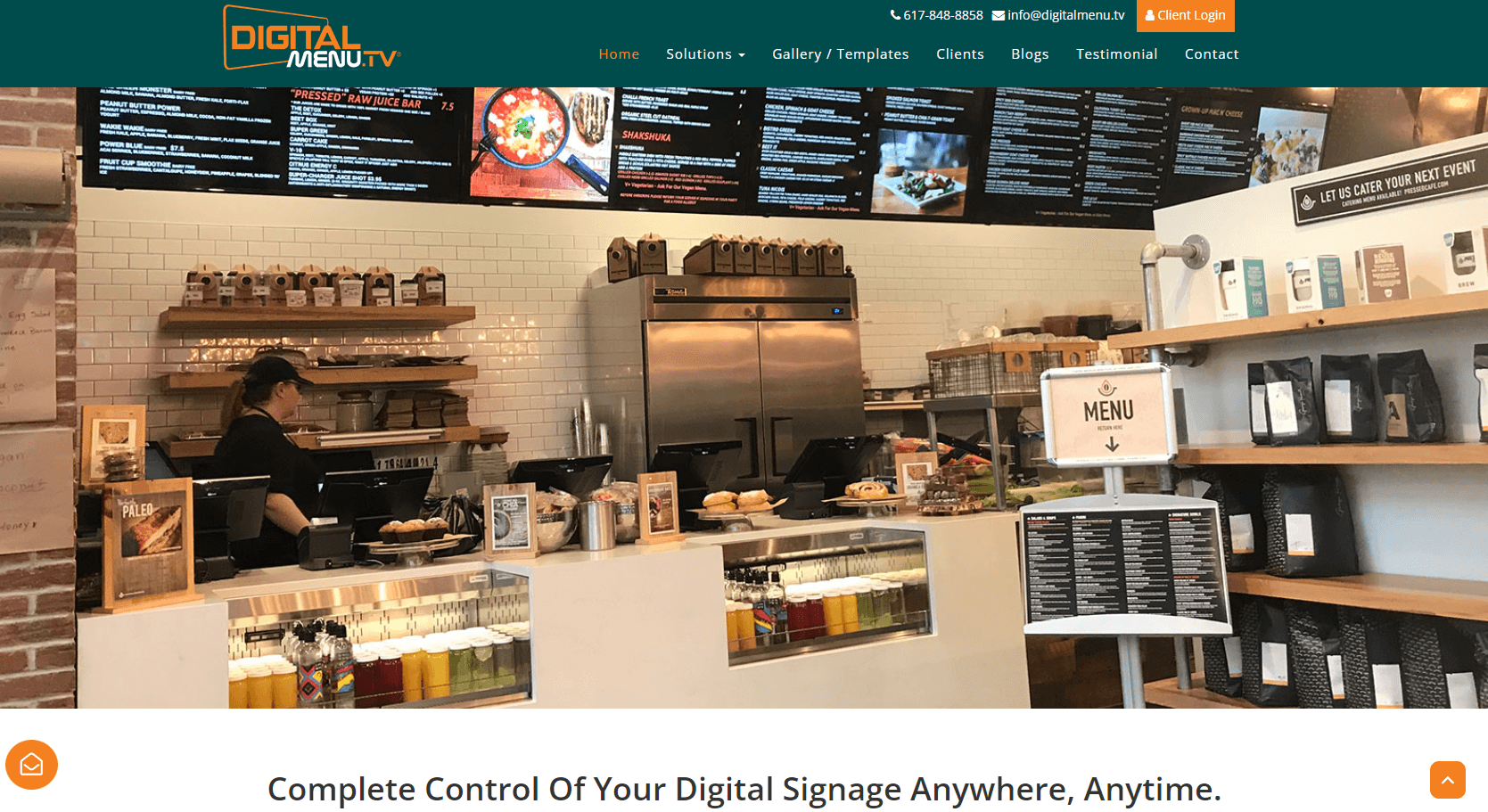
Pricing: Custom quotes only.
A restaurant-focused, design-services-led signage company. Useful if you'd rather hand off menu design entirely than learn Canva or an editor. Pricing is opaque — expect higher than commodity SaaS, lower than full agency engagement.
6. DoPublicity — best for offline / no-internet sites
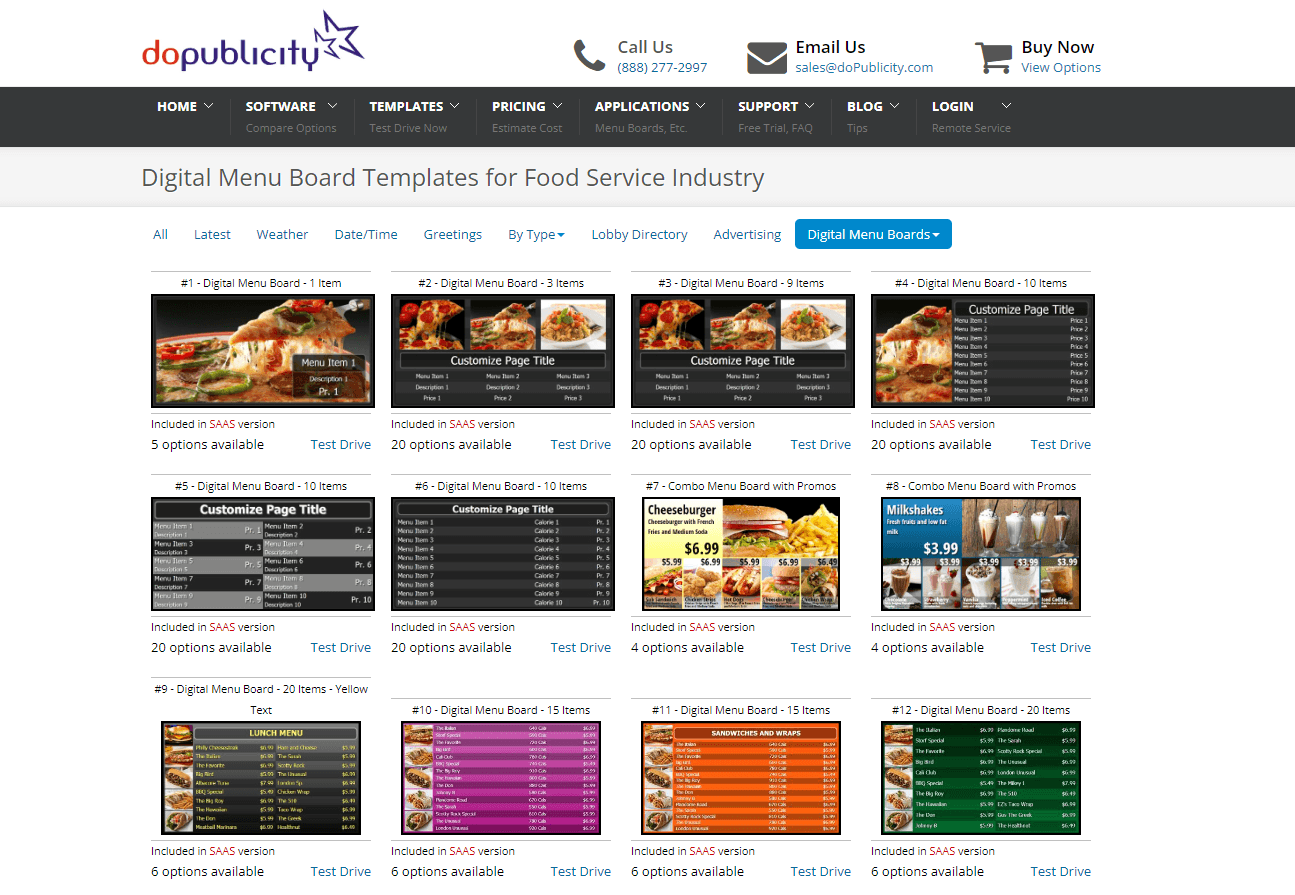
Pricing: $499 for hardware + one year service (annual).
If your site has unreliable internet (warehouses, remote retail), DoPublicity ships an offline-capable media player with the software baked in. One-time annual fee per screen rather than month-by-month. Templates included. The interface looks dated — that's the trade.
7. SkyKit — best for mid-market companies wanting signage + visitor management in one
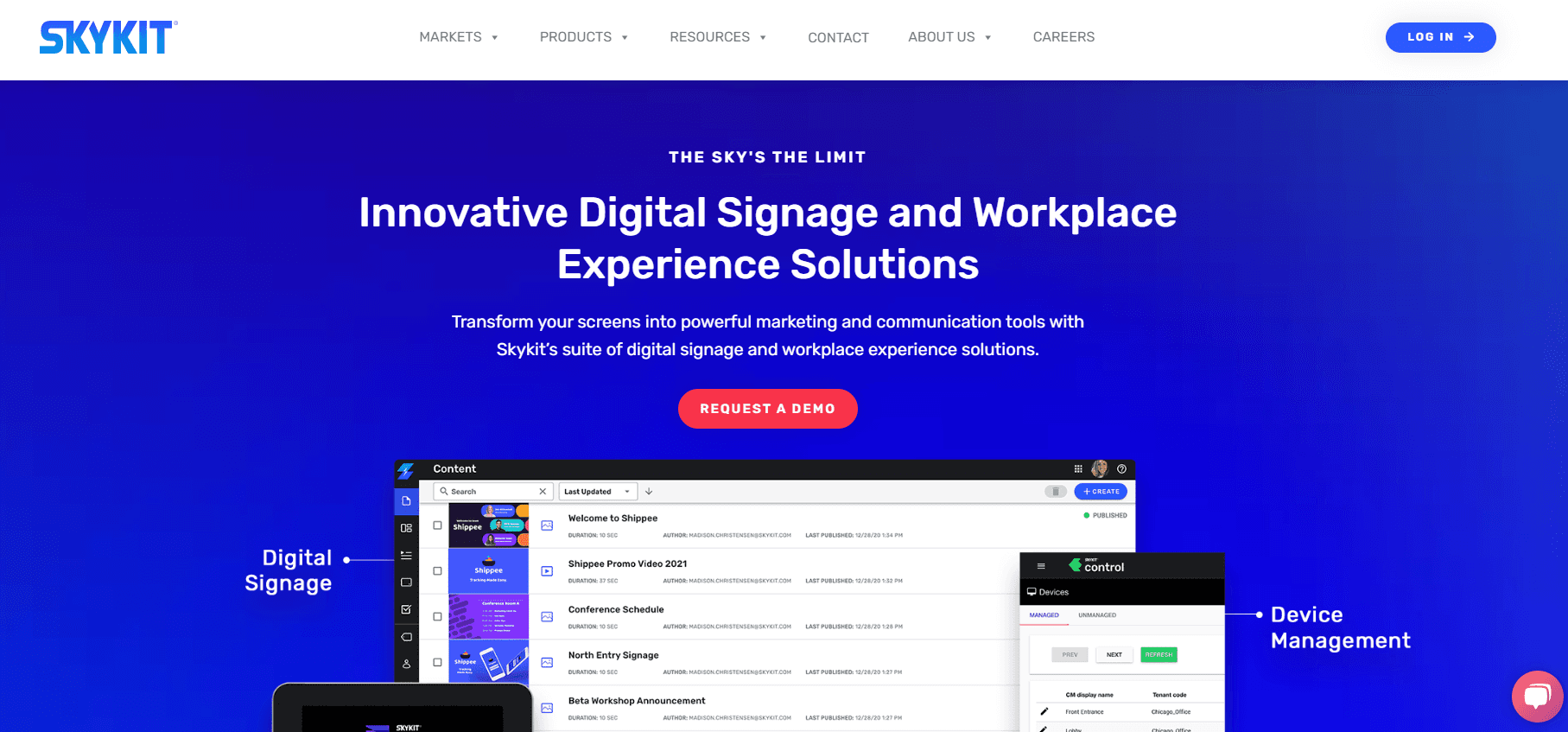
Pricing: $16.50–$33/screen/month, hardware included; kiosks and check-ins extra.
SkyKit is a "workplace platform" — signage is one module, visitor check-in and space management are others. Worth considering if you'd otherwise be buying three products. If you only need signage, it's overkill.
8. SnapComms — best for internal employee comms
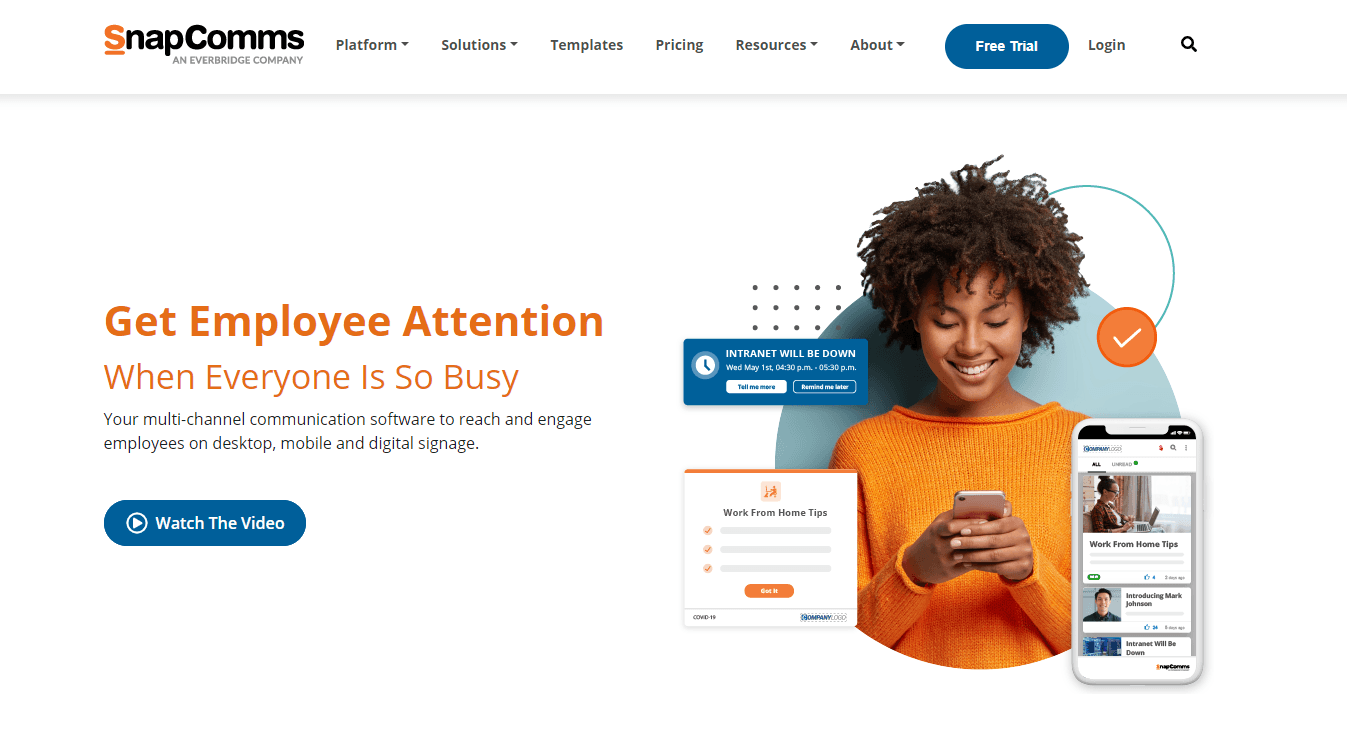
Pricing: Contact sales.
SnapComms is really a desktop-alert and employee-comms platform that includes signage. If your priority is reaching every employee on every device (desktop, mobile, screens), this is the angle. As a pure signage tool it's expensive.
9. truDigital — best for franchise multi-location with hardware support
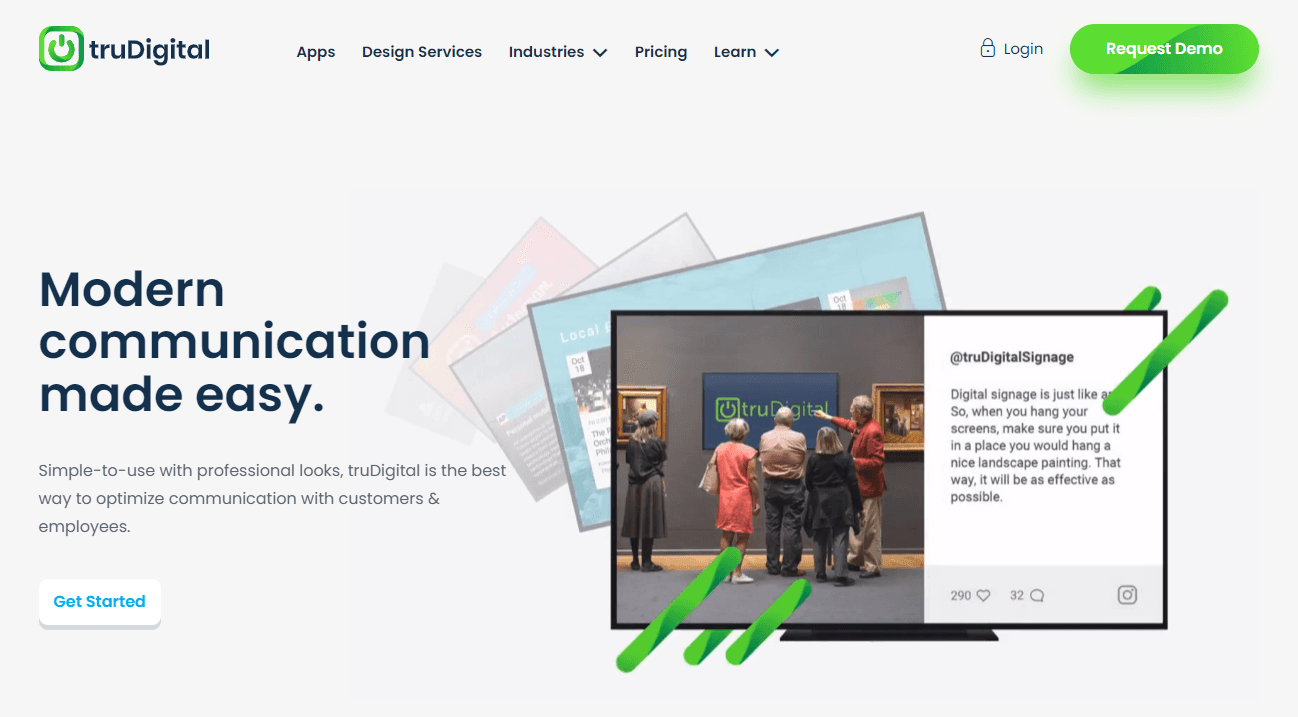
Pricing: $29–$49/screen/month + $249+ per media player.
truDigital ships proprietary media players and includes onboarding and a dedicated rep on the Pro plan. That's a lot of help if you're rolling out 50 screens across franchise locations. It's also more expensive than ScreenCloud per screen, with a hardware bill on top.
10. Look (Look Digital Signage) — best if you want a clean editor under $15/screen
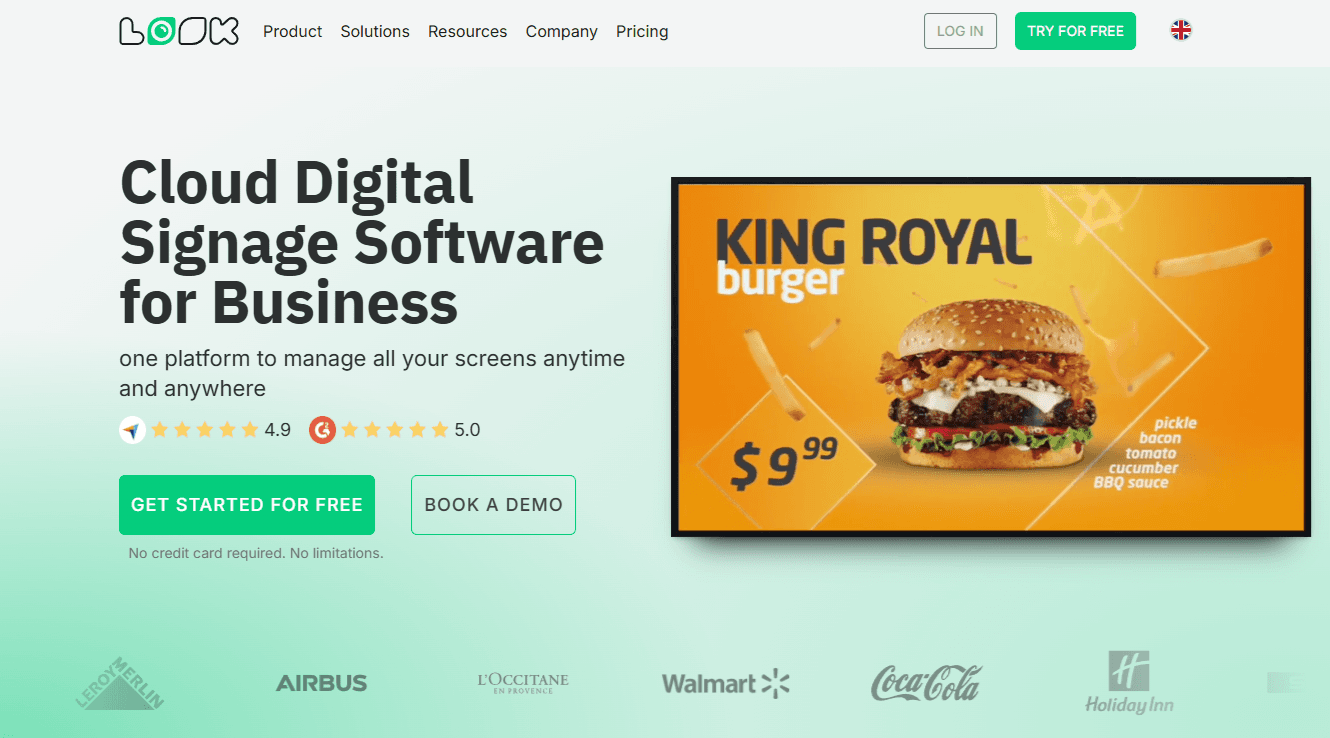
Pricing: $13.50/screen/month.
Look has one of the better-looking design editors in the category, plus offline playback and uptime monitoring. Single tier, predictable pricing. Fewer integrations than ScreenCloud or NoviSign.
11. Scala — best for on-premise and audience-measurement integrations
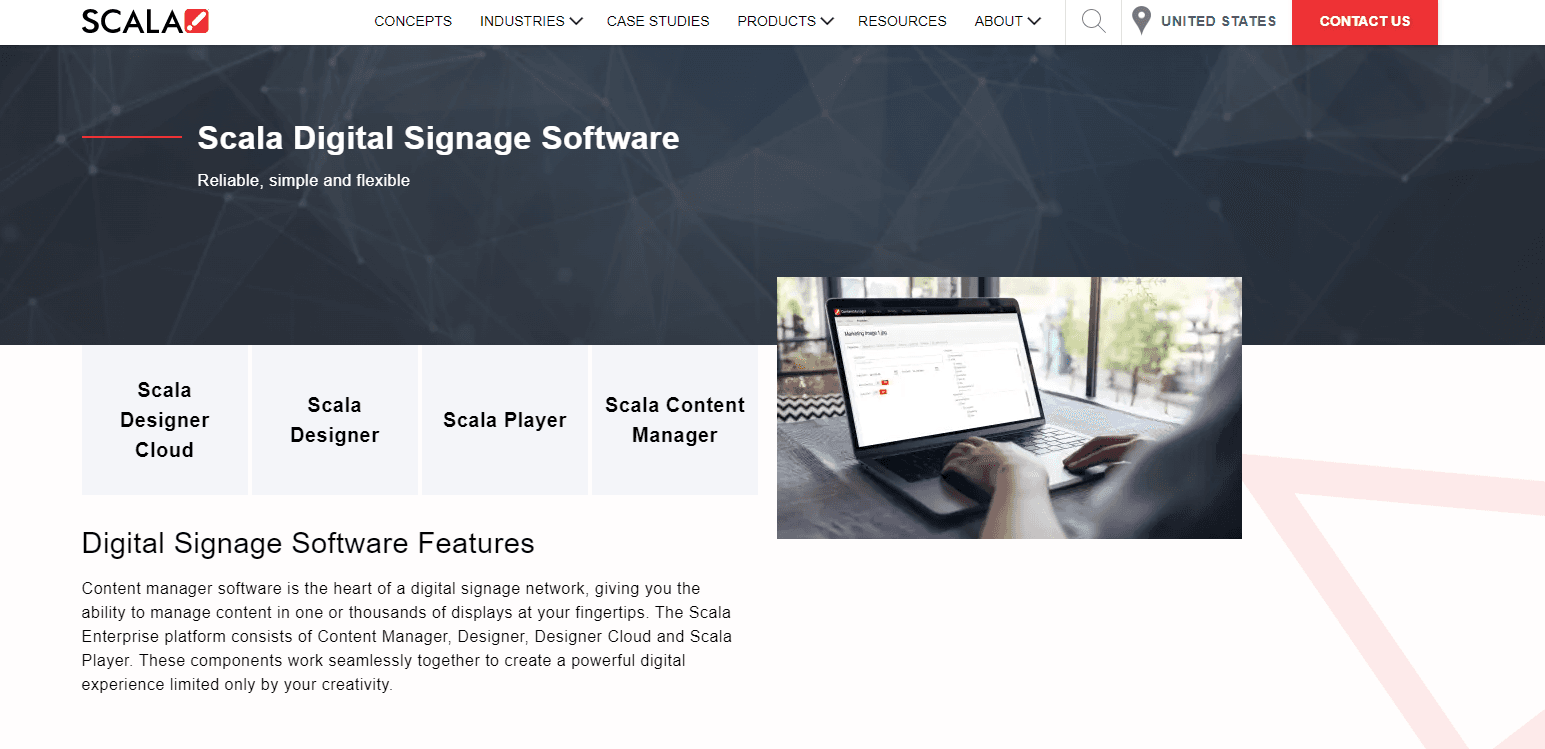
Pricing: Custom enterprise contracts only.
Scala is the right call when you specifically need on-premise deployment, proprietary hardware, or built-in audience-measurement and POS integrations. Quote-driven, with custom hardware. If your enterprise need is governance and scale, Juuno's Growth and White Label plans cover that ground at a fraction of the cost — reach for Scala when the requirement is one of the specific capabilities above.
12. Userful — best for video walls and dashboards
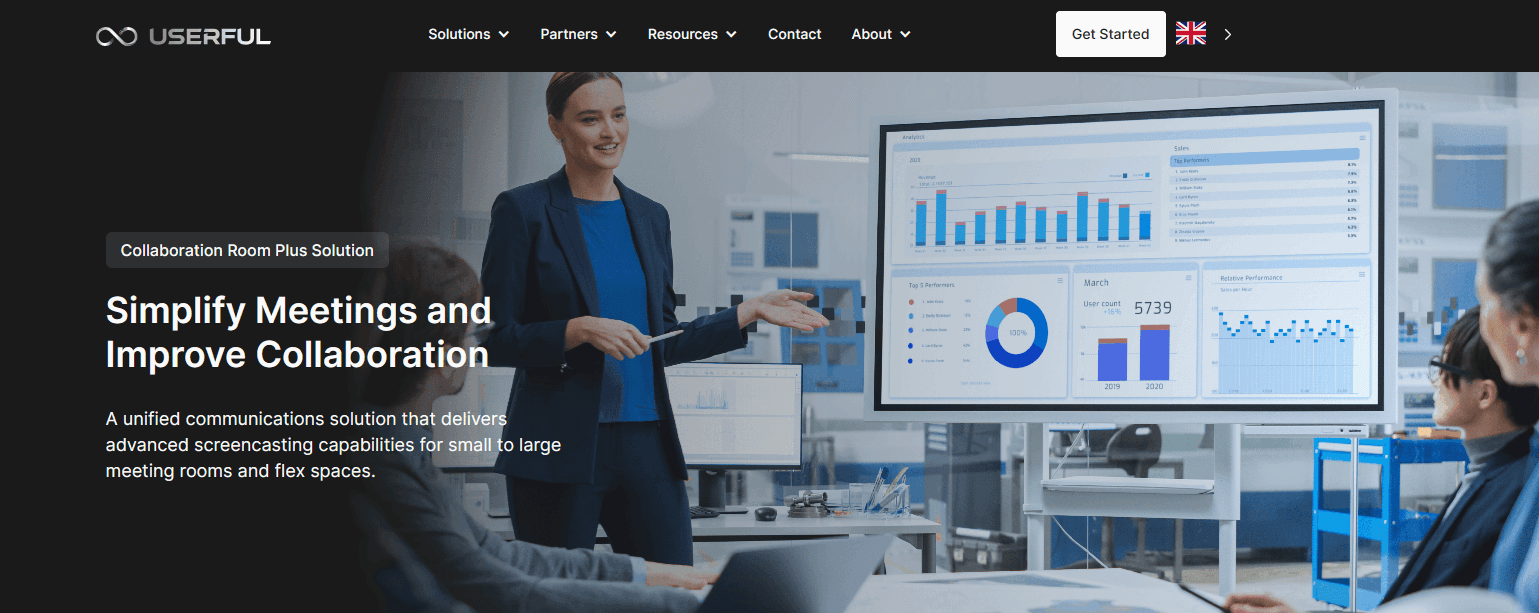
Pricing: Custom enterprise contracts only.
Userful is what you choose when "digital signage" overlaps with "control room": video walls, multi-source streaming, KPI dashboards, REST API. Same Scala territory — quote-driven, not screen-by-screen.
13. Viewneo — best for event venues and retail
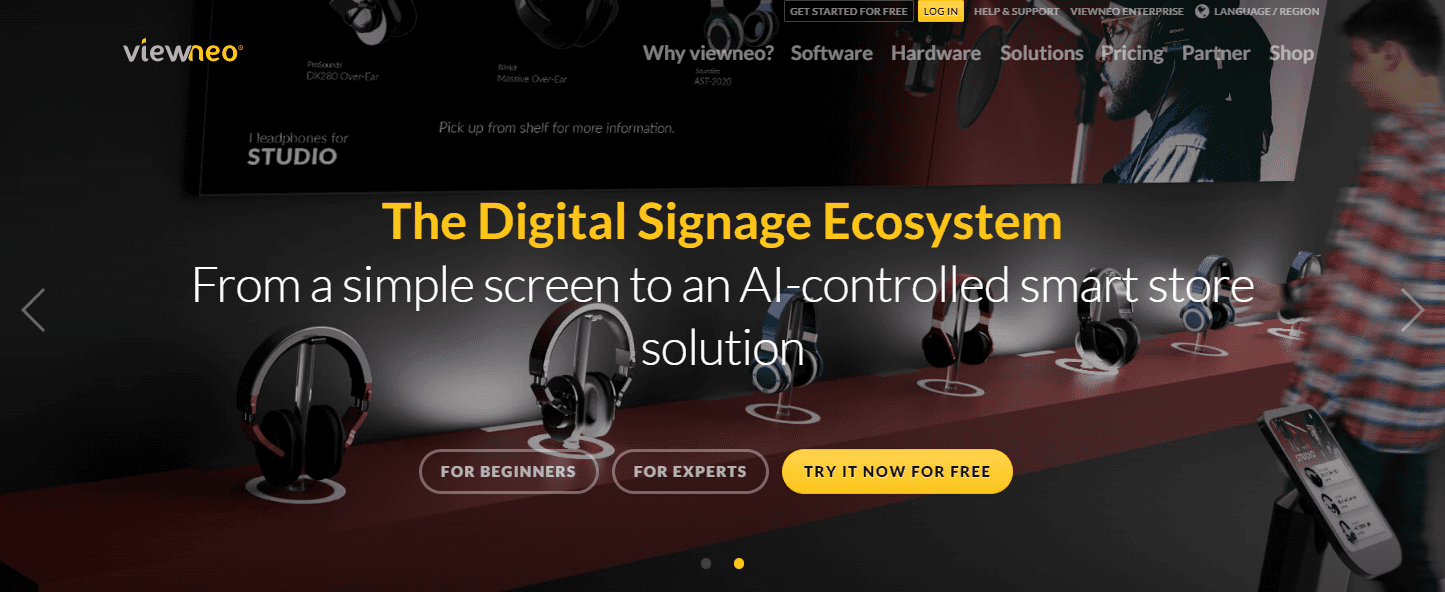
Pricing: From $21/screen/month. Enterprise from $280/month + $17/screen.
Viewneo leans into analytics and Zapier integration. Useful if you want to trigger content based on events from another tool (POS, CRM). Pricing tracks ScreenCloud closely, so you're switching for fit, not savings.
My recommendation: which alternative is right for you?
Here's the short version. We recommend that you pick the best digital signage software by use case, not feature checklist.
If you are… | Pick | Why |
|---|---|---|
A café, restaurant, gym, clinic, or small office | Juuno | $5/screen, no media players, Canva-native. Closest to ScreenCloud's core experience without the price. |
A retail store wanting touchscreen kiosks | OptiSigns or NoviSign | Both include kiosk support without enterprise pricing. |
A school or non-profit | NoviSign or Viewneo | NoviSign has a non-profit discount; Viewneo's template library is strong for classrooms. |
A franchise with 20+ locations and IT-managed hardware | Juuno White Label or truDigital | Juuno White Label suits centralised marketing teams running screens across many locations; truDigital adds proprietary hardware and a dedicated rep. |
A multi-location enterprise with central marketing and IT | Juuno White Label or ScreenCloud | Juuno scales to 1,000+ screens via Growth and White Label without the ScreenCloud price. ScreenCloud is worth the premium if your specific need is multi-tenant approval workflows. |
Need on-premise, proprietary hardware, or audience-measurement | Scala or Userful | These are the genuine differentiators — the rest of the enterprise category overlaps heavily with what Juuno already covers. |
Comfortable with hardware, want the lowest possible cost | Yodeck | Free first screen, Raspberry Pi tradeoff is real but manageable. |
Frequently asked questions
How much does ScreenCloud cost per month?
ScreenCloud's Core plan is $20 per screen per month, billed annually. The Pro plan is $30 per screen per month. Enterprise (25-screen minimum) is custom-quoted. For 10 screens on Pro, that's $3,600 a year before tax. For comparison, Juuno is $5 per screen per month — the same 10 screens cost $600 a year.
Is there a free ScreenCloud alternative?
Yes. Yodeck offers one screen free forever — a genuine free tier, not a trial. If you need more than one screen, Juuno's 7-day free trial (no credit card required) is the fastest way to test a like-for-like swap at $5/screen/month after that.
Is Juuno really cheaper than ScreenCloud, or is the $5 a starter rate?
$5/screen/month is the Business plan and includes unlimited playlists, scheduling, Canva integration, and screen zones. The $9 Growth plan adds proof-of-play and API access — still less than half of ScreenCloud Core. The White Label plan ($100/month base) is built for agencies, resellers, and large enterprise rollouts.
Will my smart TVs work with these alternatives?
Most modern smart TVs (Samsung Tizen, LG webOS, Android TV, Google TV) have a browser that runs Juuno, OptiSigns, NoviSign, and Look directly. For TVs without a browser, a $99 Amazon Signage Stick plugged into HDMI handles it.
Can Juuno handle a 500+ screen enterprise deployment?
Yes. The Growth plan ($9/screen) adds API access and proof-of-play reporting for audit trails, and the White Label plan is designed for centralised marketing teams, agencies, and resellers running screens across many locations or business units. There's no enterprise-only contract gating — the same browser-based architecture scales from one screen to thousands.
Can I keep my existing ScreenCloud media players?
ScreenCloud's media players are locked to ScreenCloud's software. To switch, you either use the smart TV's built-in browser, or replace the media player with an Amazon Signage Stick or similar. The hardware swap is usually cheaper than one month of ScreenCloud.
What about content I've already built in ScreenCloud?
Designs built in Canva (or any image/video editor) port over directly. ScreenCloud's "Apps" don't, but most alternatives have equivalents (RSS, weather, social feeds, calendar).
How long does the switch take?
For under 10 screens, most teams are fully migrated in a weekend. Larger rollouts typically run a phased migration over a few weeks, location by location. The bottleneck is usually re-creating any complex playlists, not the technical setup.
How much does switching from ScreenCloud to Juuno actually save at my screen count?
Check the cost table earlier in this article for your exact screen count. At 10 screens you save roughly $1,800 a year. At 50, roughly $9,000. At 100, roughly $30,000, using Pro rates as ScreenCloud's Enterprise floor since Enterprise itself is quote-only. The savings scale with your screen count rather than shrinking as you grow, since Juuno's per-screen rate stays flat.
The shortest path
Open a free Juuno trial, point it towards one of your TVs, and run a side-by-side for a week. For most small businesses comparing the two, Juuno is the best digital signage software at a quarter of ScreenCloud's price.


Mike Hill is CEO and Co-founder of Juuno, a digital signage platform used across 20,000+ screens in 128 countries. Before Juuno, he spent over a decade running advertising agencies, including as CEO. Juuno is his third software product. He's hands-on across product, development, and customer support, and has worked directly with thousands of businesses on their digital signage setups.
